

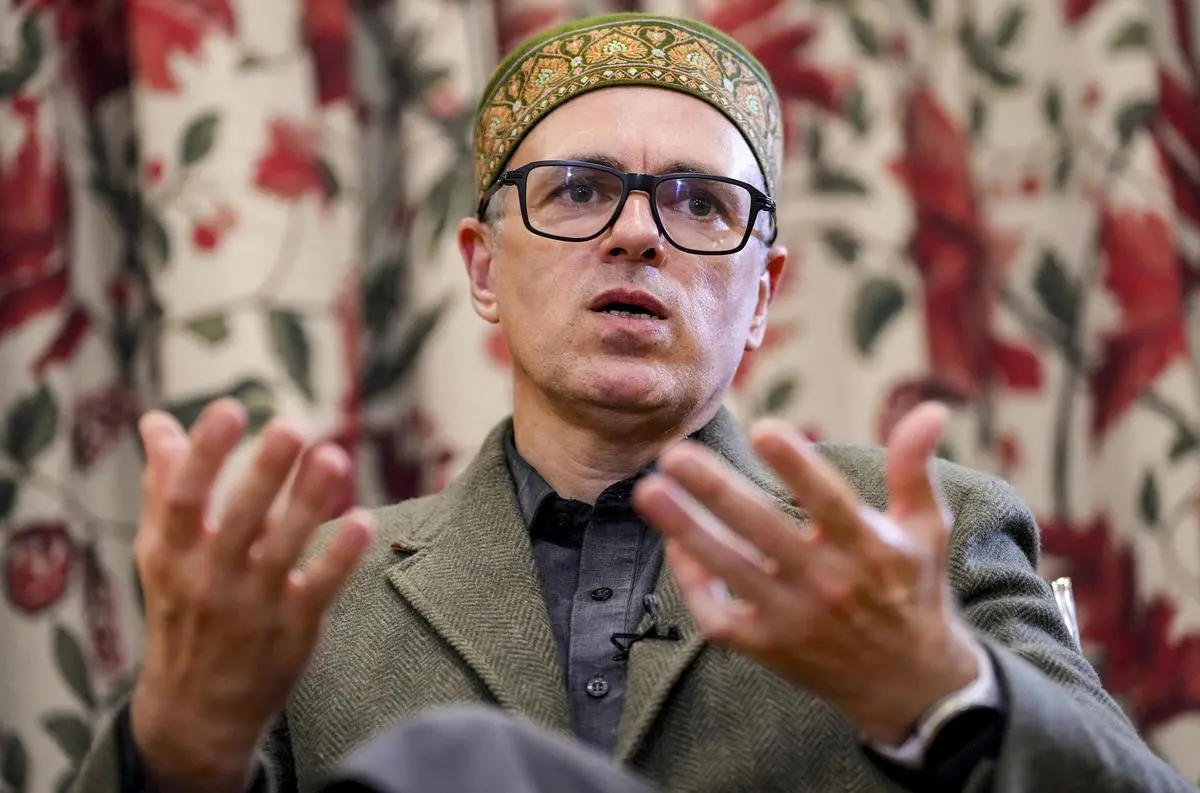
Jammu and Kashmir Chief Minister Omar Abdullah stated on Friday that Tamil Nadu Governor Rajendra Vishwanath Arlekar acted prematurely in rejecting a request from TVK leader Vijay for government formation. Abdullah emphasized that Vijay should be given the opportunity to demonstrate the support required to establish a majority in the assembly.
The Tamilaga Vettri Kazhagam (TVK) currently lacks the simple majority necessary to form the government in Tamil Nadu. With 234 members in the assembly, the threshold stands at 118. Despite the Congress party extending its support with five MLAs, Vijay’s TVK remains short of the required numbers.
In his remarks, Abdullah pointed out the legal framework emphasizing the practice of allowing the single largest party a chance to form a government. He referenced several Supreme Court rulings that bolster this stance, asserting that President’s rule in Tamil Nadu lacks justification.
Abdullah stated, “Supreme Court judgements indicate that there should be no President’s rule. The courts have consistently ruled that the single largest party should be invited to form the government post-elections and allowed to prove its majority on the assembly floor.”
He presented a historical context, recalling instances from Indian politics, including when former Prime Minister A.B. Vajpayee managed to form a government for 13 days without an immediate show of support. The President invited Vajpayee to form a government, but he ultimately resigned when unable to command a majority.
The Jammu and Kashmir Chief Minister emphasized, “If we consider the judicial precedents, the Lok Bhavan in Tamil Nadu has no valid grounds to prevent this process from unfolding.”
Abdullah urged that Vijay should be allowed to pursue the formation of government and assert his majority. “If he proves his majority, he will maintain his position; otherwise, he will have to resign,” he concluded.
The decision of the Tamil Nadu Governor to halt Vijay’s bid for forming the government raises several questions about the political landscape in Tamil Nadu and the governance approach post-elections. Political analysts suggest that Abdullah’s comments could play a pivotal role in the ongoing debates surrounding the legitimacy of the assembly formation process under the current political dynamics.
As the situation develops, all eyes remain on the governance structures in Tamil Nadu, with the ruling party and opposition parties weighing their next moves in response to this emerging scenario.