
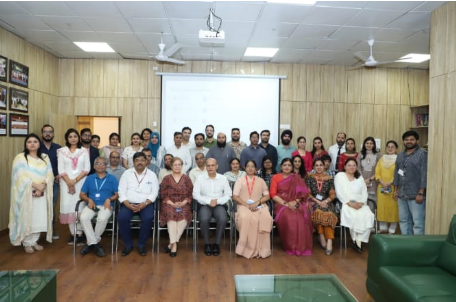
Jammu, October 8, 2026: Government Medical College (GMC) Jammu, in collaboration with the Indian Council of Medical Research (ICMR), conducted a pivotal two-day workshop on October 7-8, 2026, to address cancer prevention and survival strategies in Jammu & Kashmir and Ladakh.
This workshop gathered a diverse group of stakeholders, including senior officials from the government, seasoned medical professionals, researchers, and programme officers. Their collective goal centered on creating actionable strategies to enhance cancer prevention, screening, diagnosis, and treatment services, specifically for breast, oral, cervical, and gastric cancers within the region.
The pressing need for early detection and effective management of these cancers drove the importance of this initiative. By uniting expertise from scientific and healthcare domains, the workshop aimed to pinpoint existing gaps in services and foster appropriate interventions tailored to local needs.
Focus on Practical Challenges in Health Interventions
The workshop’s sessions, led by notable figures like Dr. Ashutosh Gupta, Principal of GMC Jammu, and Dr. Jyotsna Suri, HOD of Pathology, delved deep into the practical challenges of implementing health interventions. The ICMR team, including Dr. Nisha Jose, Dr. Pramit Gosh, Dr. Bhawana Sirohi, Dr. Supriya Malik, and Dr. Bisavjit Dubashi, emphasized creating programs responsive to local health scenarios.
Moreover, a session on data management led by Dr. Pulkit Verma underscored the significance of effective data collection and monitoring systems to enhance evidence-based healthcare interventions.
Proposals to Improve Breast Cancer Survival
A focal point of the workshop revolved around developing a proposal aimed at increasing breast cancer survival rates in Jammu & Kashmir. This initiative targets several challenges in the breast cancer care continuum, such as awareness, early detection, prompt diagnosis, and accessibility to treatment services. Stakeholders discussed evidence-based strategies that could lead to measurable improvements in patient outcomes.
Integrated Cancer Screening Strategies
Another essential aspect of the workshop was the blueprint for an integrated approach to the prevention and screening of major cancers. This strategy seeks to bolster population-level cancer prevention efforts and enhance early detection methods, utilizing the existing resources within the health system effectively. Participants contemplated methods for identifying high-risk individuals, boosting screening capabilities, and establishing efficient referral pathways for necessary investigations.
By hosting the workshop at GMC Jammu, ICMR facilitated crucial interactions between national research authorities and local healthcare professionals, highlighting the essential nature of collaborative efforts in public health initiatives. The involvement of top officials from the UT administration, along with academic leaders from GMC Jammu, exemplified the import of multidisciplinary participation in drafting effective public health strategies.
Future Directions for Cancer Care
The outcomes of the workshop promise several advancements in cancer care, which include:
- Strengthening awareness and prevention initiatives for cancer.
- Enhancing population-based screening programmes.
- Encouraging early detection and timely diagnosis of cancers.
- Improving referral networks and care continuity.
- Reforming breast cancer treatment paths and outcomes.
- Creating adaptable intervention plans based on evidence.
- Bolstering data management through advanced digital platforms.
- Generating valuable implementation evidence to shape future cancer control initiatives.
- Facilitating greater coordination between various stakeholders.
A Step Towards Enhanced Cancer Outcomes
The ICMR workshop represents a landmark initiative towards crafting a well-coordinated, evidence-driven cancer control strategy tailored for Jammu & Kashmir and Ladakh. By bringing together policymakers, researchers, clinicians, and stakeholders, this programme aims to bridge the gap between research insights and practical healthcare applications, ensuring that recent advances in cancer prevention translate into tangible advantages for patients. The core mission remains clear: to improve early cancer detection, provide timely treatment access, and ultimately enhance the survival and quality of life for affected individuals in the region.