

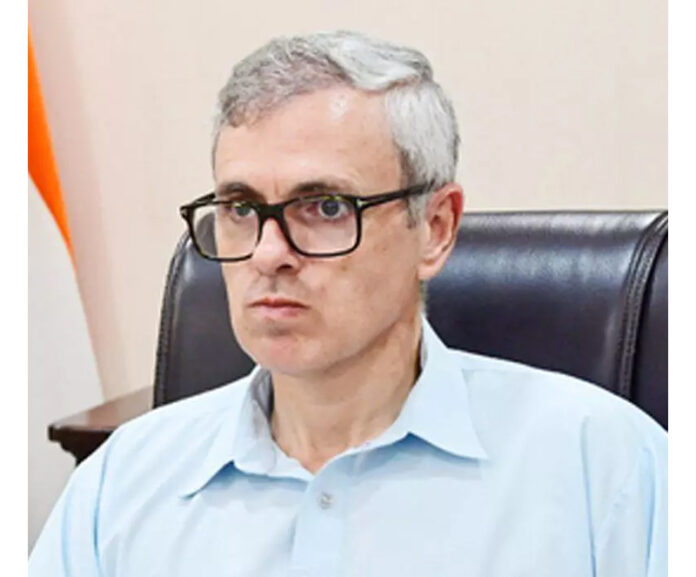
In a significant public outcry, Jammu and Kashmir Chief Minister Omar Abdullah on Thursday demanded that Bihar Chief Minister Nitish Kumar issue an apology to the woman doctor whose veil was removed during a government function in Patna. The incident, occurring on Monday at the Bihar Secretariat, has ignited widespread controversy and raised questions about decorum and respect for women’s dignity in political circles.
The incident unfolded during an appointment letter distribution ceremony for AYUSH doctors, where Kumar reportedly remarked, “What is this?” while pulling down the doctor’s naqab. Abdullah expressed shock at the act, labeling it unacceptable, and insisted that no justification exists for such behavior. “Would you do such an act? I would not,” Abdullah stated, emphasizing the importance of respecting individuals’ personal space.
Abdullah revealed that the concerned doctor has since declined to accept her appointment letter and will not join government service. He asserted, “Nitish Kumar should apologize to her and persuade her to take up the job.” This statement underlines a growing sentiment among many who feel the incident reflects deeper societal issues regarding gender respect and the empowerment of women in society.
In response to the unfolding controversy, Abdullah dismissed comments made by Union Minister and BJP leader Giriraj Singh, who defended Kumar’s actions. He argued that if a Muslim leader had behaved similarly towards a Hindu woman, public outrage would have been immediate and severe. “But since the woman here is Muslim, the BJP finds nothing wrong,” Abdullah noted, pointing out the double standards that often pervade political discourse.
Emphasizing that the issue transcends religious lines, Abdullah urged Kumar to reflect on his actions. He asked rhetorically, “How can anyone touch a woman’s clothes like this? Why did the Chief Minister feel the need to do so?” His comments have sparked conversations about the dignity of women and the necessity for politicians to uphold respect at all times.
Beyond the immediate implications of this incident, Abdullah also addressed broader political narratives. He responded to Congress leader Prithviraj Chavan, who suggested a “total defeat” in an aerial fight with Pakistan. Abdullah refuted the claim as Chavan’s personal view, reiterating that the Congress and other opposition parties have largely supported the government and armed forces following the recent Pahalgam terror attack.
During his visit to Patna, Abdullah participated in the 11th edition of India’s International Movement to Unite Nations (IIMUN) Role Model Series. He discussed the “idea of India” and the historical decision of Jammu and Kashmir to accede to India at the time of Partition. He stated, “I come from a Muslim-majority State which could have gone with Pakistan… Yet Jammu and Kashmir chose India. That choice defines the idea of India we must protect.”
Abdullah expressed concern over the differing ideas of India and highlighted the importance of democratic discourse. He indicated that while varying perspectives are essential, it is democracy and majority rule that should foster meaningful debate.
On the topic of merit and selection processes, Abdullah criticized discussions that prioritize religious identity over qualifications. He referred to controversies surrounding medical college admissions in Jammu and Kashmir, specifically criticizing the scrutiny faced by the recent admissions at Vaishno Devi Medical College where 42 out of 50 students were Muslims. He voiced similar frustrations over discussions regarding the composition of the J&K football team for the Santosh Trophy.
“The only balance that should matter is between the talented and the untalented,” Abdullah asserted. He highlighted that the future he envisions for the children of India is one where merit alone determines success, regardless of religious identity. “If someone passes the exam or plays football well, their religion should be irrelevant,” he concluded. Abdullah’s remarks about the importance of meritocracy reflect a broader sentiment aiming to reshape the discourse around education and opportunity in the region.