

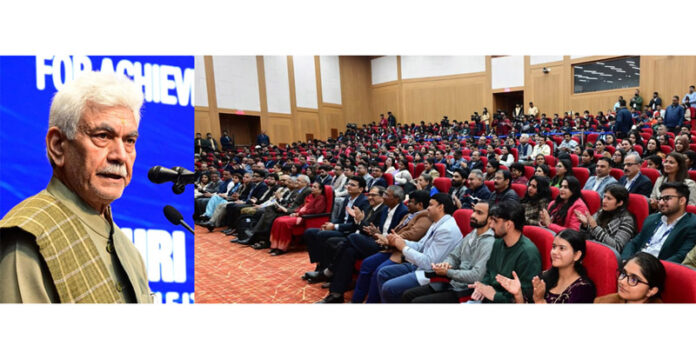
Lieutenant Governor Manoj Sinha declared on Monday that large parts of India have made significant strides against terrorism, with local recruitment into extremist groups in Jammu and Kashmir nearing an all-time low.
While addressing a three-day Strategic Management Forum (SMF) Conference at the Indian Institute of Management (IIM), Jammu, Sinha noted that only a few pockets of northeastern India still grapple with terrorism. He emphasized that the region has largely become free from extremist activities.
“Large parts of the country have been freed from terrorism. Except for a few pockets, most of the northeast has become terrorism-free. The threat of left-wing extremism and Naxalism is now confined to just two or three districts,” Sinha stated.
Turning his focus on Jammu and Kashmir, Sinha asserted that there are currently no top commanders of terrorist organizations alive in the region.
“Local recruitment into terrorism has sharply declined, with hardly one or two youths being recruited now,” he revealed.
However, he blamed Pakistan for ongoing attempts to infiltrate terrorists across the border. Those crossing into India are said to be hiding in dense forests and challenging terrains of the area. “I assure you, with certainty, they will be eliminated. No matter how long it takes, they will not survive,” Sinha reaffirmed.
Sinha pointed out that terrorism has transformed, with even educated individuals now being drawn into extremist activities. He urged that the fight against terrorism must not only rely on security agencies. “The society and specific government sectors must also contribute,” he emphasized.
He called for an end to the divisive “insider-outsider” narrative, which he believes hampers the development process of the region.
Discussing the ambitious vision of “Viksit Bharat by 2047,” Sinha highlighted the critical role of policymakers and business leaders in navigating India’s path. “Our focus should be on macroeconomic stability, high investment in education and health, digital engagement, as well as transparency and accountability in project implementation,” he advised.
He lauded India’s rapid growth trajectory under Prime Minister Narendra Modi, noting, “There is renewed confidence among industry leaders. The Prime Minister’s promotion of Swadeshi has revitalized sectors like manufacturing and handicrafts, allowing them to compete on a global scale.”
Sinha also emphasized Jammu and Kashmir’s untapped economic potential, particularly in mineral resources. Citing its vast reserves of limestone, sapphire, lithium, and more, he estimated that strategic development could yield an additional annual revenue of Rs 15,000 to Rs 20,000 crore within the next five to seven years.
Moreover, he stressed the need to maximize the hydropower sector’s capacity and suggested reforms to the Holistic Agriculture Development Programme (HADP) to align with emerging economic needs.
On this occasion, the Lieutenant Governor unveiled the Basohli Painting Exhibition and participated in the closing session of the Basohli Painting Workshop, acknowledging the contributions of local artists. “Basohli Painting is our invaluable artistic heritage, which holds immense significance for present and future generations,” he stated.
The event saw the participation of various dignitaries, including academics, policymakers, and industry leaders. Present were Prof B.S. Sahay, Director IIM Jammu; R.K. Chaudhary, Chairman JERC J&K and Ladakh; Subash Chandra Meena, Economic Advisor at NITI Aayog; and many others.