

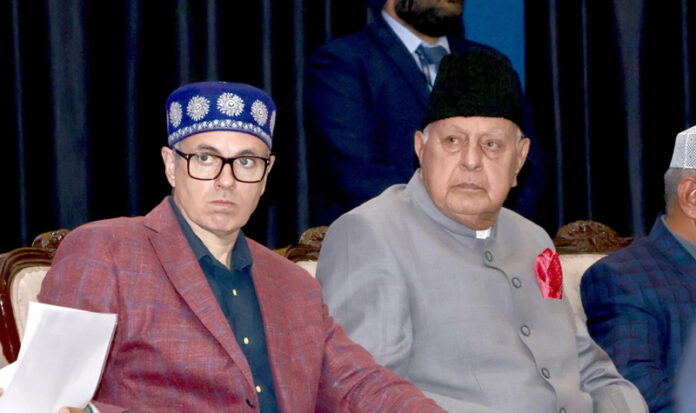
Former Chief Minister and National Conference president Dr. Farooq Abdullah stated that Jammu is moving towards inclusive development under Chief Minister Omar Abdullah. This shift comes after years of hollow promises and a lack of effective governance, allowing citizens to breathe easier.
In a meeting with a National Conference delegation, Abdullah emphasized that the current government has reinstated public trust in democratic processes. By opening the corridors of power to common people, the government aims to address long-standing issues previously neglected during the BJP’s rule.
The delegation presented various public grievances, reflecting the accumulated challenges over the past decade. They acknowledged the corrective measures undertaken by the Omar Abdullah-led government, which they believe are essential for Jammu’s recovery.
Dr. Farooq Abdullah assured party members that the National Conference is aware of the hardships experienced under previous undemocratic governance. He praised the current administration for working diligently to restore faith in democratic institutions across Jammu and Kashmir.
Addressing the highly-discussed Smart City project, Abdullah critiqued its implementation, citing recent rainfall and ensuing waterlogging as proof of inadequate preparations. This situation raised concerns about the credibility of the project.
Highlighting government initiatives, Abdullah noted significant progress regarding the Mubarak Mandi heritage complex, which has suffered neglect in the past. He detailed the introduction of free transport for women, additional ration quotas easing the plight of impoverished families, and the revival of the Darbar Move—a practice that promises to stimulate economic activity and support traders in Jammu.
Abdullah also pointed out ongoing projects, including the development of ropeways and lakes in Jammu city, which he believes will help position Jammu as a prominent player on India’s tourism landscape.
The emphasis on democratic engagement continues as Dr. Abdullah urged party workers to gear up for the forthcoming Urban Local Body (ULB) and Panchayat elections. He encouraged them to strengthen their outreach, especially regarding youth and women, ensuring governance aligns with community aspirations.
In another significant address, Chief Minister Omar Abdullah highlighted the necessity for scientific research on the effects of climate change and reservation policies concerning the Gujjar-Bakerwal community. Speaking at the Gurjar Desh Charitable Trust event, he honored the late Dr. Masud Ahmed Choudhary and urged the community to leverage its academic institutions for impactful research.
“Channeling our talent into climate research will empower the Gujjar community,” Abdullah asserted, pointing out that the community’s traditional nomadic lifestyle makes it particularly susceptible to climate fluctuations.
He further advocated for enhancing educational facilities, including Gujjar hostels, schools, and mobile education systems, while also calling for a thorough evaluation of reservation policies.
“Despite discussions on reservation, we lack comprehensive studies assessing its actual impact,” he noted, underlining the importance of data-driven policymaking.
Both Abdullahs rallied for unity within the community and reaffirmed the fundamental role of education in securing brighter futures for upcoming generations. The gathering saw several dignitaries, including Ministers, MLAs, and community representatives, emphasizing the collective commitment to progress.