

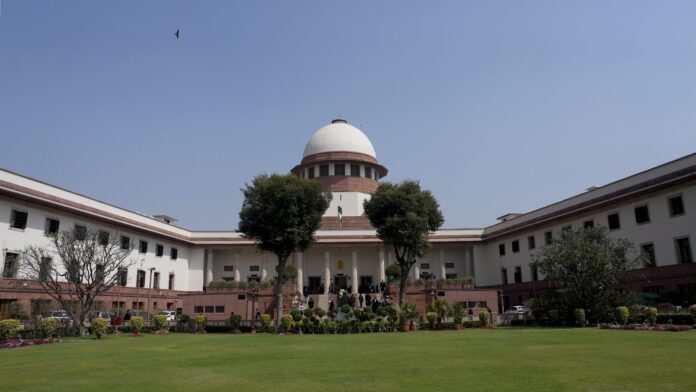
The Supreme Court of India has expressed alarm over a disturbing trend where judges issue numerous judicial orders just before their retirement. Chief Justice of India (CJI) Justice Surya Kant described this behavior as akin to a batter “hitting sixes in the final overs” of a cricket match. This statement emerged during a hearing concerning a Madhya Pradesh Principal District and Sessions Judge, who contested his suspension just 10 days prior to his scheduled retirement.
During the bench’s discussions, which also included Justices Joymalya Bagchi and Vipul M. Pancholi, CJI Kant stated, “It is an unfortunate trend. There is a growing tendency of judges passing so many orders just before retirement.” He further remarked that the petitioner began “hitting sixes” right before his impending retirement, indicating concerns about the motivations behind such judicial actions.
The judicial officer faced suspension on November 19, just over a week before retiring on November 30. This suspension followed a Full Court decision of the Madhya Pradesh High Court and was allegedly influenced by two specific judicial orders he issued.
Senior advocate Vipin Sanghi, representing the petitioner, defended the officer’s record, emphasizing that he had performed commendably throughout his career and received excellent evaluations in his Annual Confidential Reports (ACRs). Sanghi questioned, “How can an officer be suspended for judicial orders which are appealable and can be corrected by higher courts?” This highlights the complex debate surrounding judicial accountability and the integrity of the judicial system.
The Supreme Court recognized the validity of Sanghi’s argument, indicating that disciplinary action typically does not arise from judicial errors. Yet, CJI Kant raised an important distinction, questioning what occurs if the orders in question are “palpably dishonest?” This reflects the Court’s need to balance the principles of judicial independence with necessary oversight regarding judicial conduct.
In a noteworthy turn, on November 20, the Supreme Court directed the Madhya Pradesh Government to increase the retirement age of judicial officials from 60 to 61 years, effectively allowing the petitioner to now retire on November 30, 2026. CJI Kant pointed out that the suspending orders occurred without the judicial officer being aware of this critical extension.
Additionally, the Bench inquired why the petitioner had not first sought relief through the High Court. In response, Sanghi explained that due to the Full Court’s decision becoming the basis of his suspension, the petitioner believed it wise to approach the Supreme Court directly. However, the court cautioned that Full Court decisions have been overturned by High Courts in prior cases, suggesting a potential avenue for the officer’s appeal.
The Court further expressed disapproval regarding the officer’s attempt to gather information on his suspension through the Right to Information (RTI) Act. The Bench indicated that it was inappropriate for a senior judicial officer to follow this path, recommending instead that he submit a representation outlining his grievances.
In conclusion, while the Supreme Court declined to entertain the petition directly, it granted the judicial officer the liberty to approach the Madhya Pradesh High Court to submit a representation for the recall of his suspension order. The Court instructed the High Court to act on the representation promptly, ensuring a timely review of the judicial officer’s circumstances within four weeks.