
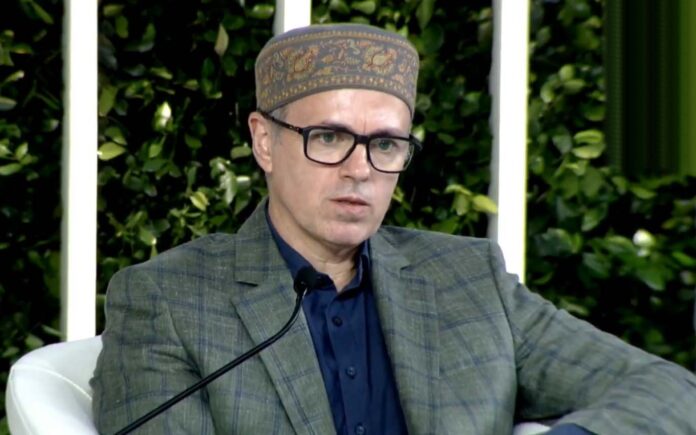
On Wednesday, Jammu and Kashmir Chief Minister Omar Abdullah voiced his concerns about the region’s administrative arrangements, characterizing his office as one of “disempowerment.” He expressed his unique misfortune of transitioning from leading a state with extensive powers to heading a Union Territory, which he claims has significantly lesser authority than any other State Chief Minister.
Speaking at an event organized by a prominent national newspaper, Abdullah criticized the ongoing interference from the Lieutenant Governor’s office. He emphasized his demand for a clear timeline for the restoration of Statehood to Jammu and Kashmir. Abdullah stated, “It is very difficult to reconcile the terms ‘Union Territory’ and ‘Jammu and Kashmir’ in the same sentence.”
Expressing frustration over the Union Territory status, he remarked, “I hate being reminded that we are a Union Territory,” highlighting that during his previous term as Chief Minister, officials never felt compelled to emphasize the status of the state.
Abdullah raised concerns about an “asymmetrical” distribution of power in Jammu and Kashmir. He pointed out that Lieutenant Governor Manoj Sinha continues to assume responsibilities typically associated with an elected government, such as chairing the Jammu and Kashmir Power Development Corporation. He questioned, “What business does someone responsible for security have holding a tourism meeting?”
Further, Abdullah noted that significant cabinet decisions, including modifications related to reservation percentages, are pending with the Lieutenant Governor, indicating a governance bottleneck. “There is an asymmetrical allocation of power between the elected and unelected government,” he asserted.
On the issue of restoring Statehood, Abdullah reminded the Centre of the three-step process announced earlier—delimitation, elections, and finally, Statehood. He queried, “Two steps are complete. Why are we made to wait for the third?” He urged the government to clearly define what constitutes an appropriate timeline for this transition.
Challenging the Centre, he requested transparency, saying, “If it is when the BJP comes to power, then be honest so people can decide.” Abdullah also commented on the restoration of Article 370, suggesting it would only occur post a change in government at the Centre. He stated, “It is pointless asking the people who took it away from us to give it back,” underscoring his commitment to special status without making unrealistic promises to the people.
Addressing the issue of radicalization and governance, Abdullah cautioned that excessive nationalism and punitive measures contribute to growing discontent. He criticized the practice of demolishing homes in the aftermath of terror attacks, highlighting a recent incident where properties were destroyed after a terror event in Pahalgam, only to reveal no local involvement. “If those people are radicalized, whose fault is it?” Abdullah questioned.
He also touched on controversies surrounding sports teams and medical college admissions, where the majority of selected candidates were Muslims, expressing concern, “When you push an entire community to the margins, how can you expect no reaction?”
In terms of national politics, Abdullah described the opposition INDIA bloc as being frequently in the ICU or on ventilator support, acknowledging that issues such as Article 370 are not currently on its agenda. Regarding Congress leader Rahul Gandhi’s silence on Jammu and Kashmir affairs, Abdullah defended him, suggesting that winning an election was paramount before addressing such matters.
In a personal deviation from his father Farooq Abdullah’s views, Omar rejected the claims of EVM tampering, asserting, “I believe we should own our defeats and correct our mistakes,” and instead criticized constituency delimitation for hampering their electoral prospects.
Earlier in his address, Abdullah also commented on environmental issues, noting pollution and prolonged dry spells affecting Srinagar, stressing the valley’s geographical features that trap smog. He countered the notion that tourism is the primary economic driver in Jammu and Kashmir, stating that tourism ranks fourth in terms of contributions to the Gross State Domestic Product, following agriculture, horticulture, and industry.